Book Review: Amar Akbar Anthony by Siddharth Bhatia

A few years back, Harper COllins India commissioned a Film Series, the first few of which included Jaane  Bhi Do Yaaron, Deewar, etc. These books were envisaged to be a throwback to some of the absolute cult movies of Bollywood from the yesteryears – movies that command a huge fan base, had some expected or unexpected things going in their favor, and a lot of interesting back-stories.

Somewhere, I feel the inspiration for this series must have been Anupama Chopra’s Sholay, a fantastic book that goes behind the making of Sholay and is a delightful read. The book from HC’s Film Series that stays closest to that exercise is Jai Arjun’s Jaane Bhi Do Yaaron.

I picked Amar Akbar Anthony in the hope of killing a couple of hours in a mall, as I waited for a movie show to start. Having read a few pages, I knew that this one doesn’t fit my expectations.

To set the record straight, the expectation I have from this series are – a lot of history, dollops of behind the scenes, a lot of trivia, and the process of making this film, which, by design or by accident, ended up becoming such a craze.

The book starts off well with a few nuggets and anecdotes, some soundbytes from those associated with the film, and some stories. However, it does two things which make it a rather boring read less than halfway through the reading – a) it starts dissecting the social construct around the times the movie was made, and gets into a critique of Manji’s movie making, and b) it wastes a lot of real estate by either repeating the same things over and over again (secular undertones of the movie, for instance), or by narrating scenes from the movie (the entire movie is narrated, and then some scenes are talked about over and over again – like the meeting between Vinood Khanna and Pran, or the mirror scene). I always thought the audience of this book is not someone who has not even seen the movie or has no idea about it, but rather one who is in love with it, and just can’t get enough of it.

After a while, I could start skimming paragraphs after paragraphs because there was hardly anything new. Worse still, it isn’t a heavy book. It almost feels like that research worth two chapters has been extended to fill a book by giving overemphasis to the author’s opinions on Manmohan Desai and his brand of film-making. The book is near pedantic, and seems severely out of water when the author is dissecting a movie and a director who’s absolute control on Box Office was undisputed, and who could be credited with a major part of the cult of Amitabh Bachchan. As Siddharth right points out, AAA was the turning point of Bachchan’s stardom, as it helped him move away from his angry-young-man image. 

The one place where the book deserves its due is in its understanding of Kader Khan’s contribution to the movie as a dialogue writer. Also, some of the incidents, like the filming of the mirror scene in Desai’s absence, or “I am not Satyajt Ray”, do help you recover some of the investment!

However, in summary, I would not recommended this book, as it fails to deliver the promise of the series.

The Reading List

The bed side has 5 books right now –


City Adrift (hardcover) by Naresh Fernandes–
I am halfway through the book, and it has been a dry but intriguing narrative about Mumbai, its past, its cultural evolution, and its people. I am learning a lot of things about the city that I have been a part of for the last seven years. For the content, the narrative could have been a little more fluid. But I am not exactly complaining.

Amar Akbar Anthony by Siddharth Bhatia

Harper Collins had started this series of books on some of the cult movies of Bollywood. They were supposed to be a behind the scenes insight on how those movies happened to be. Jai Arjun Singh’s Jaane Bhi Do Yaaron is probably the best of the lot. Deewar, probably the worst. AAA, so far, has been a disappointment, with a little over a chapter of a thin book wasted on telling us the story. Damn it, you’ve picked a cult movie, and the person interested in the behind-the-scenes is someone who already knows the story. Get it?

Mirza Ghalib by Gulzar (Hindi) 

For those who have seen the TV series many a times, the books is a parallel running compendium. For those who have not, and enjoy good old fashioned storytelling (albeit in Urdu heavy Hindustani), there is a lot of Mirza in this beautiful book.

The Kill List by Fredrick Forsyth

Starts off in the usual FF way. The narrative and context setting is going on. The intrigue is setting in. The context is a mysterious preacher who has a confounding effect on individuals turning them into murderous fanatics, before and after 9/11. I will come back with a more detailed review later on.


The Casual Vacancy – by J K Rowling

This one’s going to be a difficult one to finish. I am halfway through, but everytime I drop the book, going back to it is a challenge.


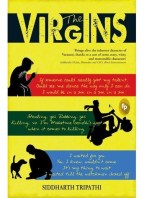
I recently finished reading Siddharth Tripathi’s The Virgins. Detailed reviews is pending, but for small-town-desis, its an extremely relatable book. The big positive – the easy narrative style. The big negative – the effort that has gone into developing the characters. However, works perfectly, if you want to pick something for an easy flight read or a quick weekend read.


What are you reading?

Book Review: The New Killer Apps by Paul Carroll and Chunka Mui

20140103-230542.jpg

Several years back, Chunka Mui and Paul Carroll had published a not entirely prophetic, but a wonderful, insightful and a hugely successful book, Unleashing The Killer App. The book was one of the front runners in establishing the disrupting impact the digital revolution was going to have on businesses. There were threads that a lot of us understand and remember, like Kodak. And there were futuristic implications, some of which came true while some did not.
With the benefit of hindsight, it is easier to be critical or defensive about your own earlier thoughts and theories. Thankfully, in their new book, Chunka and Paul move on from where they left, and build upon some of the principles they believe will shape the nature of disruptive innovation going forward.

In this book, they remodel the notion of SMAC (social, mobile, analytics and cloud) , a much abused acronym these days by technology solution providers, and identify six different mega trends (and bring in the notion of cameras and sensors). They pick a running case study, of Google’s driverless car, to highlight the multi-industry multidimensional impact such disruptive innovation can have. And they create a template of sorts for businesses to emulate, assuming they are serious about disruptive innovation.

And that’s where you as a reader have to take a call on how you see your own organization.

To push the point further, would you agree that while most businesses continue to look at incremental avenues, at the same time, in almost every business, the last few years have seen forces of disruption largely led by technology driven innovators. For instance, retail has started moving towards integrated online offline models of best buy, or the continuously pushing one’s imagination Amazon. In banking, direct banking, mobile banking, mobile payments and NFCs have transformed transactions. In insurance, a policybazaar suddenly offers you multiple choices at your fingertips or on a portal. And in the middle of all this, there are organizations which are hoping to grow at breakneck pace by using incremental methods only.

NKA busts the discussion in the middle, by asking you to focus on what can really and truly be considered a killer app. It implores you to focus on a battery of ideas while choosing your investments wisely. It urges you to stay close to your DNA, because “culture eats strategy for breakfast”. And it emphasizes the need to do away with conventionalism, by asking you to “kill all the finance guys” when you undertake the quest for a NKA.

An immensely enjoyable book, with dollops of case studies, unfortunately primarily from USA, relatable challenge scenarios that businesses struggled against, overcame, or failed to work around, and a breezy narration make it a worthwhile buy. However, the real value of this book would be to convert it into a template of sorts that you can go back to your own whiteboard with, and start re-examining your investments critically against. You may realize soon that some of your strategic investments are misplaced, some are overambitious, some have not been evaluated, and some lack the planned design that even innovation needs to have. Probably, the biggest reason I enjoyed the book is because it gives one a way of structurally nurturing creativity and imagination inside a large organization.

I have already posted a short review on amazon, which is here.

I would go in with a 8 on 10 on this book, primarily because its one of those rare business books which is not bloated, pedantic or preachy, despite being immensely insightful. And its a quick read.

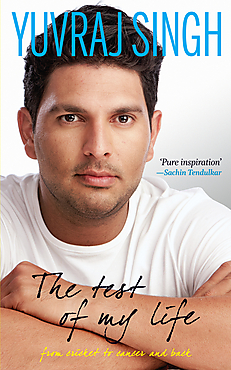
Book Review – The Test of My Life – From Cricket to Cancer and Back

the-test-of-my-life-from-cricket-to-cancer-and-back-hardcover-Have you ever started your day with an abrupt cough and vomiting attack? Imagine a tooth pain, can you? How does the drudgery of going to the office or college or school feel like on that day? Are you able to focus? Now multiply that discomfort several times over. And then, imagine trying to focus hard enough to win a world cup. And be the player of the tournament. Fathom the magnitude? That’s what Yuvraj did in 2012, as he overcame major personal odds to win the tournament. Yuvi pours out his heart in this chronicle of his fight against Cancer. Abruptly at times, incoherent at times, but with his heart in the right place most of the times.

This book is not exactly an inspirational book, like most such books are expected to be. It’s just a heartfelt chronicle. It starts with his denial of the disease, and ends with his eventually successful treatment of it. It is not a tale of heroism. It is not a glorification of how this victory was achieved. And thankfully, it gives credit where its due. The people around Yuvi who helped him wade through this journey. The resources he had at his disposal. And probably, most importantly, his mother.

The book was kind of personal to me. Over the last couple of years, we have gone through a similar journey, where sometimes the very act of living gets discounted by the fight for survival. Moving from a test to another, one opinion to another, one chemotherapy session to another. You know that you don’t have an option but to fight, but it becomes difficult every now and then. Somewhere when I was reading through the book, the book was an insight into how my dad might have felt over these months. We do not have the kind of resources that Yuvi might have had at his disposal, but I am sure the fight of mind over body does not become easier just because you have the best doctors looking at you. So, for that, I am glad that I read this book.

The book does not carry much of a literary value. Its language is unpolished, and fairly inconsistent. The timelines are fuzzy, and the editors have done a rushed job on the book. I would say that it’s a purely commercial act, and that ends up discounting Yuvi’s ordeal a fair bit. But thankfully, somewhat like Rafa’s sectional autobiography, the book has a very honest sound to it, and that’s what makes it an OK read. A somewhat more interesting story that runs parallel throughout is Yuvi’s relationship with his father. It makes you wonder if it was even a remotely healthy one or not. And how did such an unhealthy relationship become the foundation of such a promising sportsperson.

At this juncture, it’s difficult to say whether Yuvi will ever be a permanent fixture of the Indian Test team, but it suffices to say that several years back, when he opened the gates to the grand entrance, he almost blew them open. His talent is unquestionable, his work ethics has often been questioned, and his achievements do not stand true to his potential. Yet.

I think the true segment for this book is cricket lovers, and not people who are looking for an inspirational tale of fight-back. Someone who has no relation with the game may not even appreciate it. Not for cancer survivors really, because Lance Armstrong’s book is a better one for that. And I don’t enjoy the sports called cycling much.

And lastly, Dear Yuvi, you should not have used the book for such a heavy parading of your twitter presence and your charitable foundation. Seemed like an overdose by the end of it.

Book Review: The Bankster

If we look around the crop of current surge of Indian authors, there are very few that will stand out as writing taut, gripping stuff. The so called best-sellers are dealing with what I’d carefully classify as “easy reading” aimed at an audience which is still coming to terms with one of three things – English as the predominant language of their life, the perception of life at or around IITs/IIMs or other such hallowed portals (replace educational institution with financial, advisory, advertising, manufacturing, or any other such workplace and it would be the same), and lastly, a critical/modern look at the Indian cultural ethos (re-interpreting the Mahabharata or Ramayana, or a subsection from the Epic Indian literature that the generation of currently 30+ were fed on). The better Indian literature transcends these categories – Premchand had the ability to look at a common indian’s life, and so did Tagore. An “Anaamdas Ka Potha” from Hazariprasad Dwivedi had the ability to merge the philosophy of Aham Brahmasmi with the quest of an individual, and lace it with heavy doses of dark satire.

In the realm of one and two – simplification of english as a language for the people curious to know about Banking (and its pitholes), Ravi Subramanian has written four books before this  one. The Bankster, is a “financial thriller”, trying to trace the common origins of three stories – that of the corrupt insides of a large multinational bank, a socio-political unrest against a nuclear plant and an international arms dealer network. However, at its heart, its a story about a financial institution, and how the internal people, processes and attitudes create and drive varying levels of corruptions which have a second, a third, or a fourth degree impact on people and their lives. And by simplifying a lot of retail banking operations, Ravi manages to keep the book interesting.

The stories run in parallel till they converge, and quite seamlessly (even if a little too simplistically), except that the arms dealer track seems a little too subsidised while the banker track is overemphasised. This could be a function of Ravi’s professional background and focus on the financial institution story. The build up of the bank story, benaami accounts, fraud prevention, internal manipulations, corrupt practices, and several such small day to day things are captured quite well. Ravi manages to create a large number of interesting characters, but loses them somewhere in the grand scheme of things. Right from Vikram, Indrani, Tanuja, Nikhil, etc. to the Menon’s and their back stories, the Jaishankars, and so on. So much so that the end seems trivialised a great deal, and the nexus too simple. The faceless Joseph Braganza seems a little too puny in the end. The language, mannerisms and styles of different characters get muddled up along the way, with probably the exception of Tanuja.

Its the bank story where Ravi has got most of the detailing close and interesting. The arms track is the weakest, and has one of the biggest loopholes in the story. The way the third track starts building up, around an old man’s protest against the establishment, keeps you intrigued for a bit and shows a lot of promise. But then again, it collapses towards the end.

The book maintains a breezy pace, and is loaded with large number of small and interesting events to keep your mind busy. The Vikram-Tanuja banter could have been better. An interesting strength or weakness, depending on how you see it, is that there isn’t really anyone who occupies too much of space in the book. So, you are never too bothered about who the pivot of the story is.

I’d still give a thumbs up for this book and go with a 5 on 10. We as a breed of “english authors” are evolving and hopefully, the next one from Ravi will be continue to become better (I couldnt finish his previous one – If God Was A Banker).

Afterthought: I am very happy to note the kind of forum/audience a lot of budding Indian authors are getting now. Several people around me have published. Unfortunately, somewhere on this highway, our Hindi/ Urdu/ regional language literature is losing its way.

This review is a part of the Book Reviews Program at BlogAdda.com . Participate now to get free books!

Book Review: When The Snow Melts ( Vinod Joseph)

After a short gap, I again signed up to review a book under the blogadda book review program. First, about the program itself – I think it’s a great idea as it serves two purposes – it gives bloggers a chance to take their blogging seriously (with the realization that you might be representing something bigger than yourself), and at the same time, it creates a network effect/ word of mouth for some good books written by upcoming Indian authors.

The book that I lined up for a review is – When The Snow Melts, by Vinod George Joseph. I first came across Vinod several years back, when he was active contributor for Epic India e-magainze. The e-zine is long defunct, and so are the few forums where saw Vinod’s writing. So, it was good to see that he had published something, and not just something, but a thriller.

About the book

From amazon: Veteran spook Ritwik Kumar is sent by the Indian government to the Intelligence Assessment Group (IAG) in London, where intelligence agents from all over the world work together to fight global terrorism. The IAG has a few pet projects: nabbing Osama bin Laden and Mullah Omar is one; purging Pakistan’s secret service agency, the ISI, of rogue elements and fundamentalists, is another. Despite years of working in Central Asia and Afghanistan, things don’t go well for Ritwik at the IAG. Addiction to alcohol and gambling drive him to borrow heavily from loan sharks and even misappropriate office funds. When Ritwik’s senior officer, General West, gives him only a fortnight to return the money he has stolen, Ritwik defects to the al Qaeda.But he is a man who doesn’t easily fall in line and doesn’t share al Qaeda’s ideology. Events take a turn for the worse not only for Rikwik but also for all those who come in contact with him. Even the beautiful Nilofer, who is married to the al Qaeda fanatic and one-man army Junaid, is not spared. When the Snow Melts takes you through a dangerous world of diplomats, spies and fanatics, where appearances are deceptive, and danger lurks around every corner.

****

Now then! WTSM sets out to be a spy thriller set around an Indian spy working with IAG who ends up defecting to a pro-Taliban sub faction within ISI. Expectedly, the life of a defector is not too rosy to start with, since there are more people who expect the defector to be not that but a double agent. So, our protagonist, Ritwik Kumar, is in a hellhole soon enough. Or rather, moving from one to the other.

I have always been intrigued by how the best thriller writers set up a key event in a prologue which keeps you glued to the plot, and that exact setup that leads to that moment. However, my biggest disappointment from WTSM was that the prologue of the book was too simple a set up that could be smelled from a mile. X caught by bad guys, X in a mess, X shows some moves, but they are not good enough, and suddenly, X gets saved by Y, and Y knows a lot abot X already. Scene begins. You know what’s coming, right?

VGJ’s debut novel is an interesting effort in a space rather untouched by Indian authors. The recent barrage of Indian authors have abused the modern Indian male/female, life in the metros, IIMs/IITs/etc on the one end and adapted the Indian mythodology on the other. There is precious little by way of variety and style. That’s score 1 for VGJ. There are as many facts as there are myths about the Indian spooks, and you can be sure that I have been in the middle of some, given my family background. But, an interesting article to read before you start reading this book would be a recent Caravan article about the case of Madhuri Gupta. There are some minor traces of the case in the book, but that article is a good starting point if you’re new to the Indian spy world. Secondly, don’t forget that the movies have glorified spooks across the world to such heights that beatable, un-crazy spooks are not welcome, usually.

The book is a lazy afternoon read with a decent pace, but does not have much to offer. The plot is is highly predictable and the suspense not layered. The story telling is so obviously linear that it smells of a Yashraj film. It moves continuously from the same scene to the same scene without ever breaking away from the pattern. There isn’t a second vantage point in the entire book, which is its biggest weakness. If you’ve read two spy books before this, most likely, the plot will be staring in your face. In fact the surprise is that there is no surprise. From someone like VGJ, I’d have expected a lot more research into the subject. My fear is that he ended up writing the script for the next Salman Khan movie – Ek Aur Tiger. And you know that script and Salman Khan don’t quite go together, right?

The lack of context – the prologue does not explain the gambling and the debt, the IAG as an entity is never really explained, the set of caricatures that form this faction of ISI, the linkback to RAW, the way intelligence is collected, the rather talkative ring leader – these are just some of the loopholes or missing elements. The extent of stereotyping makes it worse. And there aren’t enough thrills.

The plot’s smartest setup fails because the protagonist talks too much… Or.. err.. thinks out loud too much. His doubt in the moments when he is with Niloufer, reveal the essence of the plot way up front. And the dragging end with Ritwik wanting to save Niloufer, was an avoidable mess.

So, in short, the book promises, but fails to keep them. On the positive side, the narration is breezy and well edited, and does not get boring at any point. Its one of those simple things you can do one lazy Sunday afternoon. or, when you don’t have any work at office and your twitter handle has been blocked by the government.

I remember what AKC (a friend) once remarked about bollywood movies – “These b****** have two problems – the need to explicitly explain everything. And, the need to have an explicit climax!”

If you want to read good stuff, read Mohammad Haneef’s Case of Exploding Mangoes. This one is barely passable.

.

.

.

.

This review is a part of the Book Reviews Program at BlogAdda.com. Participate now to get free books!

Some of my other book reviews are here.

Book Review: The Wednesday Soul by Sorabh Pant

It’s been a while since I reviewed a book. But the blogadda.com book review program and the fact  that I signed up for reviewing will make me come out of my slumber. And the book getting unveiled is “The Wednesday Soul” by Sorabh Pant, who is also a stand-up comedian by the day.

Plot Summary: The book is primarily about the afterlife experience of Nyra Dubey, a female vigilante , Chitr Gupta, a higher mortal/ demi-God, and their super-powered nemesis, Kutsa. The broader blurb is available on the publisher website. But in short – Girl is a vigilante, meets and likes an interesting guy one night who’s apparently invulnerable and can read people’s innocence in their eyes through a score, has a nemesis who’s despatched a few too many people to the nether world. Girl like guy, nemesis kills girl, guy and nemesis die in a clash. A whole battery of support characters come into play as the afterlife world is constructed, while the broken fragments of the mortal world come together as well. Etc Etc.

The concept of a “Wednesday soul” or “Sunday Soul” though, I believe, is driven off our expectations and evolving lifestyles. The mid-week peaking frustration making people suicidal to the Sunday being the most sacred of all days. Nyra, the central character, is a Wednesday soul, people who subconsciously drive themselves to death (say, by overworking, over-eating, putting themselves in the path of danger).

Liked : Many of the jokes and potshots. Right from Lenin spewing Russian comedy to Indian PhD in queues, to Agatha Christie connecting with Inspector Sharma in Sanskrit. The pace is fine, if not submerging. You can finish off the book in one go (or two). Its not a very complicated story, and you can get the sense that there are several ideas introduced in the book that can easily help you create more stories/ books around them. The book is irreverent and there are no holy cows in the book. And that’s where the books biggest strength is. The funny potshots at everyone and everything.

Did not like: The story at large and the narration leaves much to be desired. Far too many loop holes in the story (the character of Harithi and her ability to score cadavers for instance), and fairly incoherent storyline (Inspector Sharma’s character, or Agatha’s link with the world starting off with British English in Harithi’s head and Sanskrit instructions later), the idea of “Thinkers” viewing what’s going on in the world, but not being able to locate the Third, and the missing Sunday Soul. However, the thing that really got me was the editing and printing of the book (at least the edition I have in my hands). It’s a mess. So much so that it reminds me of Times of India. For instance – the editing jumps refers to a flying eledactyl (an elephants -pterodactyl) as Air-Awat, Ayr-Awat or Ayrawat at different places. Insignificant editing errors such as these are present in significant numbers across the book. The bigger peeve I have against the book is actually the quality of editing. The narration and character sketch is hardly consistent. Inspector Sharma graduates from good English to grammatically incorrect English in the later half. The beings do not exist in the same plain consistently. A weird character (in the earthly sense) like Chitr Gupta, fighting off goons in a lowly locality of Delhi thinks of Grey’s Anatomy and Literary Jokes in his head. There’s a subliminal level of awareness that makes most characters speak in the same language/style and intonation and binds them to the same awareness about different things, issues and people. 87 rewrites do not seem visible from an editing lens I think.

End Verdict: At 250, this one session book seems very steep. For an INR99 kind of price established by Chetan Bhagat, this book could have been a passable read. It’s a book that showcases Sorabh’s abilities as a funny person, but not as a narrator/ story-teller. What really works is that Sorabh is a stand up comedian, a funny guy, in short. What really doesn’t work is that the book does not go much beyond that. It’s a series of gags, puns, pot-shots woven together. The book has some extremely funny moments, or gags as I’d rather refer to them as. But I wouldn’t mind missing out on this book. The book is like a DJ mix of spoofing and puntastic commentary on the world beyond and the powers that be. You may dance the night, but you won’t remember why.

********************

This review is a part of the Book Reviews Program at BlogAdda.com. Participate now to get free books!

Back from hibernation

It’s been a while since I posted. And as Confused points here, at times, it almost feels like starting afresh.

Anyways, it’s not like I have stopped watching movies, reading books, meeting people, or having thoughts. It’s just that I haven’t felt like writing for a while. Or rather, not felt like typing even when I felt like writing. Tonight is different. For reasons hitherto unknown to mankind (and myself), I am back with (hopefully) a short post.

The update is that biwi Is in Bangalore now. And we are back to meeting over the weekends. Married people can’t stop pointing to the positives of it, and others do not stop sympathizing over it. Bosses, a third group altogether, do not stop worrying about the possibility of my attrition now that biwi is not in Mumbai.   Like always, everyone’s right. It’s just a matter of perspective. And I did my MBA a few years back. SO, I do have multiple perspectives on this matter. But that matter is a different matter and shall be perspectivized some other time.

Just to get my groove back, let me share my reading list for the last few weeks/months that I have not been writing much during. It’s often said that the books you read and like reflect your personality. Well, here is mine.

  • Vengeance of Ravana (Book 7 of Ramayana Series by Ashok Banker – Recommended for those who’ve read the first 6. I would strongly recommend the first 6 first)
  • The Client (Grisham – Good, but passable)
  • Matheletics (Prof. Winston, whom I had the pleasure of meeting in November. Interesting for math and analytics buffs)
  • The 65 Lakh Heist (translated version of Surinder Mohan Pathak’s 1977 classic. Recommended for Bollywood and potboiler lovers)
  • Gods of War (Ashok Banker – passable/avoidable)
  • 30 pages of a M&B (I finally decided to steal one from biwi’s collection to understand why these are so popular with women. My take for “man” kinds – definitely avoidable)
  • The Mckinsey Engagement (Paul Friga) – Recommended for budding consultants
  • Stardust (currently reading, by Rupa Swaminathan (seems interesting so far (first 70 pages, that is)
  • Snow (Orhan Pamuk – for those who like John Steinbeck kind of stuff), amongst others.  I loved it, but at the same time, was extremely disturbed by the time I finished reading it).

More importantly, I finished reading a few comics mini-series –

and have started reading

All of these came with strong recommendations. The recos were right. All of these are excellent, with V and Identity Crisis being my favorites so far.

I also read Super Commando Dhruv’s “Dhruvishya” and “Aakhiri Dhruv”, which in my view, were quite crappy. I miss the originality of the earlier comics of Dhruv Series. The quality of artwork has improved, but the stories have gone from bad to worse.

And in case I never mentioned, I read MAUS – A Survivor’s Tale a little while back, and its phenomenal. Must read!

Now that you know what my latest personality is like, what is your reading list looking like? Anything you’d like to recommend?

Roundup…. No Title

Haven’t been blogging for a while, as the seasonal lethargy takes over. I can’t really blame it on anything else. Anyway, just a roundup of things/people/songs of note –

1. Television – I am in love with the 2 singing competitions on telly these days, Zee Saregamapa 2007 Challenge – Sangeet ka Pratham Vishwayud and Amul Star Voice of India. SVOI is going through a dramatic phase with Gajendra Chauhan ( the pioneer of such singing talent hunt shows) getting confused with his self created frankenstein. However, the singers to watch out for are Toshi Sabri (brought back into SVOI by popular demand, after being ejected on the basis of public voting), Harshit (SVOI), Amaanat Ali (SRGMP, an amazing voice from Pakistan) and Raja Hassan(SRGMP). Raja has the rusticness and purity in his voice, Toshi is probably the best trained and a sufi-genre singer. Harshit will make an awesome playback singer while Amanat probably is the most versatile of the lot, and will surely make a great ghazal singer if given a chance. His rendition of “Tujhse Naaraz Nahi Zindagi” yesterday (6th Oct) was plain simple awesome. The idea behind this long para on these people is to remind you guys that for every Dhoni who came out of Jharkhand, there are several who join Tata Steel on a small stipend! Please support, encourage and look out for these raw talents in the years to come. You can see the videos online here – SRGMP, SVOI

2. Music – 1. Main Agar Kahoon (Om Shanti Om) – beautiful romantic song with a very simple melody and another proof of how good Sonu Nigam is. Especially, when it comes to romantic songs, there are few who are as good. His voice has a certain yearning that others don’t
b. Yoon Shabnami from Saawariya  sung by Parthiv Gohil. A lot of you won’t even know who Parthiv Gohil is. Parthiv is the lost find of 1998 Saregama MegaFinal (youtube videos) (the year Sonu was still hosting the show,  Sanjeevani – another finalist, got a few movies as playback singers (such as Kareeb), and there were some truly amazing singers like Mohd. Vakil, Bela, Mukund and Sudeshna). An year or two after 1998 Shreya Ghoshal became the winner of Saregama. Anyway, Paarthiv had a very strong classical learning background and his rendition of songs like Ketak Gulab Juhi, and Dhanyabhaag Seva ka Awsar Paaya back in 1998 were wonderful. So, Bhansali has given Parthiv a break, along with Monty (the music director, who played some part in the background score of Devdas)
c. Songs from Manorama – 6 feet under.  From a collection of 4 songs (excluding remixes and versions), 3 belong to the category of very good to excellent. Woh Bheege Pal, Dhundhla jo sama bandha, Tere Sawalon Ke.. Try them out.

3. Movie – Johnny Gaddar is definitely my pick from bollywood. Bourne Ultimatum would be the hollywood pick. Johnny G is a wonderful movie which takes you back to the 70s thrillers where things just kept happening all through the movie. Director’s tribute to Vijay Anand and James Hadley Chase is visible throughout the movie. The movie could have been shortened by 15 minutes or so. But, but… its a wonderful movie to see on a weekend.

4. Books – Reading “Of Love and Other Demons” by Gabriel Garcia Marquez right now. Seems good so far, while being standard Marquez narration. Will update later.

However, just in case you got a feeling that this is what is keeping me busy.. Naah!  How many of you out there have lived out of a suitcase to get a house renovated. Working your butt off five days a week to reach home on a weekend (travelling usually in the middle of night both ways) to deal with tiles, cement, paints, designs and woodwork! Ugh.. its not easy!

Btw.. quick emotional outburst – Raikonnen has taken the pole. Hamilton has to wait. Vettel seems a driver to keep an eye on. The last couple of races are going to be amazingly interesting! 😀

Book Review: Harry Potter And The Deathly Hallows

Finished off reading Harry Potter and the Deathly Hallows on Saturday itself. Had not pre-ordered it thinking I will borrow it from someone to read (well, I am not an avid HP fan!!). But then, having read the last six books, it was a big temptation to see Deathly Hallows looking at me from the windows of Crossword. Plus, the realization that I will be on a bus to Pune for the next 3-4 hours. Decision made. Target closed. Book picked up!


So, what do I think of the book? It’s a good read. But I would still rate it as a hyped book banking on the media revolution of modern times, and the fact that it’s the seventh book of a seven book series (hmph). And you can read on, I have no plans of spilling the much closely guarded secrets! [Its funny how the book leak has led to a set of blog articles around what does security mean in the modern world! – Link 1, Link 2]


What’s right with the book? It is similar to the previous six books in narration style. Simple for everyone to comprehend, lucid to keep flowing, too many sub-plots to keep you intrigued, does not get lost in details (unlike classical literature, where setting up the mood may take a few pages with all the descriptions of the woods, the color of the dog’s skin, falling leaves, etc.), continuity of characters and most importantly, a continuity of the story.

What’s wrong with the book? It gives you the feeling that JK got tired of writing this story at this point. She herself was saturated. So she decided to create the counter of Horcruxes, a concept conveniently introduced towards the fag end of the series – Hallows. So, the plots are being closed out one after the other. She didn’t want to get too bogged down in different characters, so there are deaths that just happen, without creating the same emotional trauma and action as was the case with the death of a Sirius Black or Dumbledore, or even the death of James and Lily Potter. Even the anguish felt for Neville Longbottom’s parents’ death by Cruciatus seemed better portrayed.

Despite what a lot of J K Rowling comments may have you believe, Harry, Ron and Hermione don’t seem to have grown up as human beings/wizards. While Hermione does showcase a new set of curses and spells acquired over the summer, all the wizards are seen to be using pretty much the same set of things. I mean – If Voldemort is that powerful, he should use something beyond avada kedavra – which sounds like a poor version of Indian madari’s Abra ka dabra. It reminds me of Naruto, where the only seeming growth in Naruto’s powers after 2 years (Naruto Shippuden) is that his Rasengan (Ball of Chakra) is more controlled and bigger.

The worst thing – There is a chapter which is called “19 years later” which is a desperate attempt from JKR to close the series, once and for all. Full of clichés and expected puns, the last chapter is as pathetic as it can get.

 There are several untied parts, including the immensely grown powers of Voldemort, as against Harry, who doesnt seem to be growing any more powerful, even though the pretext is that it should have happened. Something like the growth of Neo fuelling the growth of Agent Smith in The Matrix.  Again, an analysis would reveal things about the story, which I don’t want to do!

Net net, I picked the book because I just couldn’t resist the temptation. If you can resist the temptation, then borrow it from someone who has already bought the book. It’s a good read, but not worth 900 bucks or so. I can praise and nit-pick a lot more, but that would give away significant chunks of the story.  

Endnote – Chandrakanta Santati (written by Devki Nandan Khatri) was written as a set of six books. Including Chandrakanta, that would become 7 books!  While Nirja Guleri did destroy the worth of the book to a great extent (through mindless histrionics and pathetic adaptation), I still think it’s one of the greatest serial books ever written. It’s a pity that Hindi literature does not have the same reader base in India as English literature.

Book Review: The Golem’s Eye

I had posted the review of The Amulet of Samarkand quite some time back with a promise to finish the remaining two books of the The Bartimaeus Trilogy and come back with their reviews.

So, I did finish of the other two books – The Golem’s Eye and Ptolemy’s Gates over the last couple of weeks. Would I recommend? Yes. But read the complete trilogy. If you have to read just one, stop at AoS, even though PG is the best. But a lot of things in PG won’t make perfect sense unless you have read the previous two books!

Let me review the second book, The Golem’s Eye first. And then, I will start reviewing PG.

Review : TGE

Golem’s Eye is probably the worst book of the trilogy, despite being far from getting classified as a bad book. The problem with TGE is that it gives you the feeling of being a filler. Something like the several filler episodes of Naruto while Sasuke is growing in strength at Orochimaru’s castle, and Naruto is growing in Konoha. To show the growth, you need to show something happening at Konoha which is helping all the Ninjas grow.


Plot (Skip this if you are planning to read the book – Doesn’t contain spoilers, but what the heck!)

Back to TGE, the book starts off a few years after book 1, Nathaniel/John Mandrake is a prominent person in the Government’s scheme of things. However, his status and safety is under threat, as a Golem is unleashed on the city of London, by God knows who! Nathaniel, under uberpressure from all angles, turn backs to the Djinn he had thought of not summoning again, and who continues to be his best bet, Bartimaeus. Bartimaeus is full of his wise quips and antics as the two set out to solve the dual problems of Resistance & Golem that the city of London is grappling with.

Kitty, the cursory encounter with whom had left a deep imprint on both Nathaniel and Bartimaeus, makes a strong comeback as a Resistance member with an ideological/honest side. The resistance rises, gets crushed, and Kitty along with a couple of other people survives to set the stage for book 3 – PG.

The conspiratorial angle of magicians, power leading to corruption, and an innate honesty saving the day are still the main themes of the book. The allegories to modern day and historical politics/world are fairly visible. I am surprise how books like these find their way in the children’s section of bookstores. The hidden layers after layers of satire and metaphors is not something that I expect children to understand. Having said that, I think the story in itself is quite a generous dose of fantasy for children to enjoy!


My views

Where the book suffers is the shallowness of the conspiracy which does not get matched with the thickness of the book. The book could have been finished off in half the number of pages. It becomes a drag at times with all the details around things that sound better when narrated at a frantic pace. For instance, the scene at Gladstone’s tomb should definitely have been shortened, given the surge of emotions that every character would have been going through.

Good things about the book –

  1. Bridges the gap between AoS and PG nicely.
  2. The story has elements of fantasy which are nice (Golem, as a concept is quite intriguing)
  3. Nathaniel finally moves on from being the hero to the dark guy (for a big part of the novel).

Bad Things about the book –

  1. The pace
  2. There aren’t as many sub-plots in the story to wrote a 300 page book
  3. Could’ve explored Kitty’s character a little better
  4. The book has chapters narrated from the eyes of Kitty, Bartimaeus and Nathaniel. There can be chapters narrated from the evil guys’ eyes as well!
  5. While the book is titled the Golem’s Eye, Golem (I found Golem to be a very exciting concept) isn’t given a good amount of importance in a book which is more about the war between Magicians and Resistance

Back to my rating mechanism (mentioned in this post), the book holds true to 2 of the 4 parameters – attention to detail, loyalty to genre, and fails to deliver the ultimate punch on two of them – pace and content. I won’t go to the extent of saying it failed on the content. It’s the right content, but not sufficient!

Overall – Read the trilogy. It is very very gripping!

Book Review: Amulet of Samarkand

Its by a stroke of luck that I chanced upon the book (well, you can’t chance upon something good just like that, unless luck is on your side!)

It’s a good book for a weekend read. First of a three book series, known as “The Bartimaeus Trilogy“, its a book that you can pick up, and keep running with it unless you’re done with it. The pace of the book is so good that you will anyways end up running with it.

A fantasy novel set in London, the book operates in a world which is controlled by magicians that control djinns, afrits and imps, and their incantations, summons, curses are the source of their power. In this world, where the control of power is so important and malicious that this power, through an explicit rule, is not transferred through generations. It is transferred to someone outside the family whose previous identity is erased before he/she is molded into becoming a magician. In such a world, Nathaniel, adopted by a weak magician in the Ministry of Internal Affairs, Arthur Underwood, as his apprentice, summons Bartimaeus, to avenge the insult handed out to him by Simon Lovelace. But the whole plan unravels itself as he finds himself getting deeper into a very dangerous game against a very formidable foe. Let me not spoil it all by telling you the story here.

Trivia: Surprisingly enough, the Djinn in this novel, Bartimaeus, derives his name from a biblical character of the same name. However, that Bartimaeus was a blind beggar healed by Jesus Christ, and he later became a follower of Christ.


The book can be read for its imaginative storytelling, extremely fast pace, simple characters (the author does not bother with too many sub-levels of characterizations), true to its genre, and his away from the realms of everyday reality. Yes, it confirms to my check list of what defines a good book.

But I would qualify the simple characterization bit. It holds, unless you start thinking about the book at the third or the fifth plane, as Bartimaeus would have said.

The book can be seen drawing a lot of parallels with modern world, where the commoners are being controlled by magicians (wicked politicians who can’t even be true to their master, and change loyalties at the drop of a hat), who know how to control the djinns and afrits (the powerful governmental organizations that can but never fight back because of the stronghold of charms – (money?)). Some of the more powerful afrits like Ramuthra can cause a rummage, a disturbance at elemental level (Watergate scandals, et al.). Even the mildly powerful but intelligent djinns like Barthameus (the intelligence departments) can be controlled (Late Indira Gandhi would know that!), but can cause the downfall as well. The Tower of London can crush the imaginativeness and powers of all powerfull djinns. Every powerful magician has own djinns and afrits. Pity, the novel does not talk about the commoner’s life. Though it does talk about a “resistance”.
Additionally, there are a lot of references to history (Ptolemy, Disraeli, etc.), contemporary places (Tower of London, Westminister hall) and so on.

I am sure I will discover more as I read through The Golem’s Eye and Ptolemy’s Gates.

Good work Jonathan Shroud! It’s a good read.

Book Review: The Namesake


Well! I promised I’ll do this. And I don’t think I regret having made the promise.

The book is much better than the movie (of course). Somehow, things seem to fall more in place when you read the book (but, of course). Gogol does come across as an idiot, but not so much. Ashoke seems more mature. And Ashima, true to what her character should be, seems as lost as she should seem. The sister’s character has some sense (Sonia). Moushumi has a more meaningful role to play. Her past, present and future makes more sense. So does Maxine’s.


Jhumpa Lahiri’s “The Namesake”,
as opposed to Mira Nair’s “The Namesake” is an extremely mature book written in a style that bridges the gap between India and America, just as Ashok and Ashima’s life tries to. At times, it moves into the narrative style of an Indian author, where there are graphic details around the mundane details of everyday life, the way people walk and talk, their cultural heritage and how that impacts their way of thinking. At several other occasions, she is at consummate ease with the American accent, style and ways. Jhumpa gets into the skin of these characters completely, and everyone is identifiable.

GOGOL: Gogol, coming across as an ABCD in the movie, is pretty much an American with Indian parentage. He is not a wannabe American, as ABCDs are supposed to be. On the contrary, he is as Indian as anyone else. His way of thinking, getting frustrated with weekend Bengali parties, are not something that I won’t see in an Indian metro of today. Just because the setting is that of USofA, it does not make Gogol any different

ASHIMA: Ashima is the quintessential taken away from her roots, Indian woman, so diminished in identity already, being forced to find/create a new identity in an unfamiliar land. She does not share the eagerness of new-gen IT geeks who would probably hang by the wheels of an airplane to go to the States, if that could take care of the H1B issues! For her, its about speaking a language, talking about things that seem so alien to her. Especially, when you are coming from a country where talking to your relatives and neighbors is the biggest social activity. Her ordeal as her children move from her side of the world to their side of the world is very subtly laid out in the book.

ASHOKE: A very mature, and subtle individual, wizened through the age, experiences and literature he devours, Ashoke comes across the most compromising and far-sighted individual in the book. He talks in a language that smells of the future, handles situations in a way that tells you how much he is thinking, has an unwavering integrity about his character, and a simplicity that you end up loving. And his character, somehow, is one the least covered and most powerful characters in the book.

MAXINE: What the movie failed to do is to highlight Max’s lifestyle and her family. From the word go, in the novel, you can feel that their relationship is doomed, despite all love and comfort between the two. Unlike the movie, the breakup does not happen at a time when Gogol is not able to think about anything, but beyond that time, when Gogol is still not able to think of anything. A severed relationship at the time of crisis can be mended, but a relationship severed because of a drastic change in life, probably cannot.

MOUSHUMI: Does get a bit of attention in the novel. The movie again, does not do justice to the complexity of her life. The presence of Dmitri in her life, a long time fetish, her love for Paris, her inability to fit Gogol in her social life, and a dying relationship (which still survives in India because of the social boundaries) are all well detailed in the book.

Starting off with the birth of Gogol, and explained through Ashoke’s accident while he still had Nikolai Gogol in his hands, Namesake explains the need of some people to remain commoners and not really stand out in a crowd. Gogol’s biggest grudge against his name is that it makes him stand out. Nobody names their children Shakespeare, for instance. Gogol wanted to be a part of the crowd. In addition to the brown skin, which never really stops him from dating or being accepted by whites, he has a unique name to contend with. While I think about this, I am sure there must be a lot of people out there who would love to explain the history of their unique name. It makes them stand out and they probably love that!
This struggle to be a common man makes him the son of Ashoke and Ashima, common Indian people, who have a preference for being a part of the crowd. Isn’t that what defines, in large parts, what Indian society think like.
Gogol struggled to find his own place by keeping both the worlds happy. When he could not, he chose one over the other. At times, he tried to understand what the other world is like, and at times, he gave up.

For me, there are 4 things that I like to see in a book

1. Content- story – I would not call it a great story, but its high on content. The story does not tell me something that I, as an individual, have failed to notice. But it does present itself beautifully. . What does make the whole story intriguing is the way people handle their own set of challenges.
2. Attention to detail – Awesome! This is the area where Jhumpa Lahiri nails it. Even the rituals of walking, driving around the blocks, switching on the lights when Ashoke dies, the use of rooms on different occasions,
3. The pace of the book – is a little slow, but in tune with the mood. There are pages that you can quickly run through because they are quick. There are times when she wants you to devour the details, and the pages are a little slow there. But not meaningless.
4. Loyalty to the genre (a thriller should thrill, a classic should have something to stand the test of time, and should be reflective of the times when it was written) – I don’t know where The Namesake belongs. But it seems to be in place! That’s as vacuous a statement as I don’t know if Tendulkar should continue to play cricket, but I think he is playing well. Bottomling – it’s a nice book to read! It does not give me a feeling of reading a boring thriller

Read it.. especially if the movie disappointed you. At least you won’t blame Jhumpa Lahiri for writing a mundane story!

Movie Review: The Namesake


I saw the movie more than a week back. However, I was thinking of writing the review only after I have read the book as well. As Diamond would have it, the book has taken steam in the last day or so, and the review has been pending a while.

Yenniways, back I am. To talk about Gogol, Goggles, Ashoke, Ashima, America, India, Bengal, and all their Namesakes.

Of all the classical literature I have followed, somehow, I never ended up reading Nikolai Gogol. Dostoevsky, Chekhov, and Tolstoy were as much a Russian repertoire as I could get comfortable with. Anyways, the plan is to read and figure out if I have also come from Gogol’s overcoat.

The movie seems to have impressed a lot of people, but yours truly wasn’t really impressed. And for a change, the biggest disappointment was Tabu, who just doesn’t seem Bengali enough. IrfanKhan is extremely convincing in his accent and demeanor of a Bengali. Kal Penn disappoints (with due respect to his comic timing and my appreciation of his several other movies). Others don’t really have a role.

The Namesake is the story of Gogol Ganguli (or, Nikhil Ganguli) (Kal Penn), the namesake of the great Russian author Nikolai Gogol, with his unique name bestowed upon him by his father Ashoke Ganguli (Irfan) given his love with Russian literature and a past haunted by an accident.

However, rather than getting into the story, which I will definitely get into in my other post on the book review of The Namesake, I will focus on the movie.

The things I did not like about the movie (there are n number of blogs talking about how good the movie is!)

A. Settings

  • Calcutta (then, and now Kolkata) of 1974 hardly seems authentic.
  • Ashoke’s accident occurs in 1974, and he is bed ridden for one year. He goes to the US for 2 years, and that would take us to 1977. Getting married in 1977, and with a son who is nearing 25+ years at the time of going to Maxine’s house in New Hampshire, would take us to something like 2003+. I am surprised that neither Max nor Gogol had a cellphone. Surprisingly, no one in the movie had a cell phone till the time Moushumi flips one open. And even at that point, she is the only one with a cell. Everyone else uses landlines all the time.

B. Performances & Characterizations

  • Tabu’s accent is just not Bengali enough. Her accent reminds me not of a Bengali turned American, but the recent metro English movies like 15 park avenue, etc. where the artists add a musical tinge to their English. “What Rahul! I tell you. These kids no! They are just taking our generation down the drain. You don’t trust me? How mean?”
  • Kal Penn doesn’t look young enough to be a 14 year old (at the time when Ashoke gifts him the book). And he never seems irritated enough! More importantly, the story belongs to him. Somewhere Mira Nair has gone wrong in showcasing the conflict between Nikhil and Gogol.
  • His sister’s character is totally sidelined. With her first half looks, it was a good ploy, but the second half is where she should have had a role to play. However, the book is about Gogol. And Gogol’s sister probably is not important for Gogol’s existence.
  • The events are simplified a bit too much – Gogol’s hatred for his name is long drawn phenomenon where he doesn’t hate the name as much as its strangeness, its un-indianness or something like that. The trauma on his face (for the first 5 minutes after Ashoke tells him about the accident) is lost without any further analysis. And guess what – changing his name from Gogol to Nikhil is the most important thing he has done ever.
  • The divorce between Gogol and Moushumi just happens. Moushumi’s side of the story is never explained. And she does look pretty hot in some of the sequences. So my sympathies are with her. Not with the confused brat Gogol.
  • Breakup with Max! but why? What went wrong? In her own way, she wanted to be a part of the family. What went wrong there? No explanations given!
  • Gogol’s choice of being an architect. Again, too simplistic. What was he doing till the time he saw Taj? There is only one point where he is shown sketching. But what about the career shaping forces known as Indian parents, who want their kids to become doctors/engineers!!
  • I can go on and on and on. But the point remains. Some of the underlying struggle of being a namesake, a fact that haunts Gogol forever, are hardly dealt with.

I feel, as I write this review, and as I walked out of the theatre, that The Namesake is another book turned movie gone average, a fact I would never understand. When a novel is written, the authors usually creates exquisite detail around who a person is, their life, their environment, their dresses, the walls, the colors. Someone converting it into a movie, needs to be honest to the spirit of the book. But they edit and re-edit it. Thinking they are making more logical sense than the original. They underestimate the viewer. Moreover, they make the mistake of assuming that the viewer has read the book.

However, having said all this, let me take some of the harsh words back. I am being overcritical because I had high expectations from the movie. I don’t remember having the feeling of walking out of the movie during those 2 hours. SO, its definitely worth a watch. It’s a decently narrated story in chunks. Its a collage of small snippets that Mira Nair tries to walk us through in her journey of understanding Gogol. Or, maybe, that’s her understanding of Gogol. It’s a reader’s interpretation!

Overall Rating -5-6 out of 10. Bulk of that 6 is Irfan Khan. And the fact that the movie is not a bore!

Book Review: In Spite Of The Gods

Before I start commenting on the back, for the uninitiated, here is a 2-line spiel on Edward Luce, the luminary writer of this book.
Edward Luce is a Financial Times journalist who has covered India for a considerable period of time. (And his wife is an Indian). As part of his journalistic experiences, he did get to read, write and experience a fair bit of India. And the true enigma that India is, Edward is tempted to share his understanding of the profound through this book.
The name of the book – In Spite Of The Gods – The Strange Rise Of Modern India, itself tells you how a lot of people feel about India. Despite all that plagues modern India, people often surmise about what has brought India to this stage of exploding growth. Why is there so much talk about India being the next big thing in the global economy? The real answer is – Nobody Knows! It reminds me of this joke where the whole of US is baffled about “Jugaad” – a technology which ensures a 5 year tenure for a government with 20% of the seats in the parliament, which tilts the scooter at 5 degrees to start it, which provides food and shelter for those thousands of good for nothing young ones in villages who think sitting at the chaupaal and talking about Indian Politics is the biggest form of entertainment (besides periodic consumption of Chai and Gutkha), and which sums up the sentiment behind this golden statement – “Ho Jayega Saab! Aap chinta mat kijiye. Kuch jugaad to lag hi jayega!”
Anyways, back to Edward Luce and his rendition of the great (and not-so-great) story of Indian evolution. The book is very good when it comes to research, and sharing experiential learning. However, the book suffers from a very common problem. People who have not felt India, often misinterpret the chaos that prevails. Particles moving in random motion with a specified purpose often contain a powerhouse of energy within. Luce’s attempt to generalize a lot of Indian undercurrents fail at striking a chord with an Indian. Some of the opinionated generalizations are unwarranted too. However, there is no fun in reading an author if he does not have an opinion! [;)]
The thing that struck me the most was the elevation of Sonia Gandhi’s character from the common perception of an opportunistic politician. Sonia is portrayed as someone who was and is naturally averse to politics and is there in the Indian politics for a social good. Sentiments I could not just wait and see what they were trying to do with the country sound nice, but very untrue. At the same time, the hatred for Sangh Parivar and the fact that BJP has played a puppet in Sangh’s hands for long are bloated magnanimously, with there being no equal stage sharing for some of the other forms of religious paranoia plaguing our country. Not one to support the extremist acts of religious atrocities in Gujarat, it somehow paints an incomplete and unjustified picture if a “journalist” never bothers to look at all faces of the coin before forming an opinion.
The place where this book suffers the most, according to me, and I am not great orator or journalist, is that it confuses personal opinions with research facts. In the same breath, Edward talks about the facts and figures of economic growth, Nehruvian model of socialistic economic growth, and his opinions about Ravi Shankar, Sonia Gandhi, etc.
It’s a good read for those who like hypothesizing about India and the way going forward (I am one of them!), and those who love reading (seemingly) interesting anecdotes concerning popular people (oxymoron – anything related to popular people is an interesting anecdote. That’s how they became popular, right?). A little depressing for die hard Sangh fans, a little too upbeat for Congress supporters, the book is a spicy read, if nothing else!
Design a site like this with WordPress.com
Get started