Watch NH10 for Anushka
March 13, 2015 Leave a comment
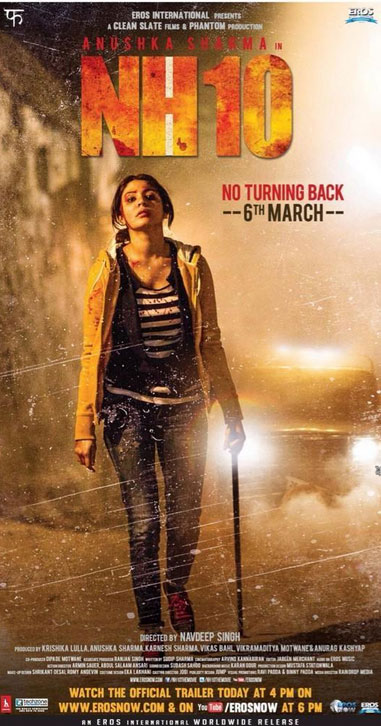
- This scene is not in the movie. Not exactly like this, at least
There are many things that need to happen in the right amount for a movie like NH10 to work. And history suggests that Bollywood has a knack of screwing those many things many times over in many movies.
For instance, in a thriller, should the lead actors necessarily sing and dance around the trees? Or, in a rather dark movie, should the protagonist emerge as a larger than life person taking on some 20-goons at the same time? And beating all of them to an unrecognizable color (black/blue/white/gold)? Or, should a story that can be told in 90 minutes be told in 150+, so that the audience feels that they have got their money’s worth?
Thankfully, NH10 manages to avoid most of these pitfalls. It’s a superbly edited edge of the seat dark thriller, elevated a few notches solely by Anushka Sharma’s performance (despite her disconcertingly gone wrong lip job).
Running at an approx. 2 hours length (probably lesser), NH10 moves at a hectic pace almost all through. And not because there are too many characters and too many sub-plots (like Gnags of Wasseypur), but because, for a change, someone hired an editor who knew what editing should do to a movie.
Anushka Sharma hits this one out of the park. Make no mistake, it’s her movie. All the way. Right from having football field size cojones to put her movie in a script like this, to acting out of her Band-Baaja-Baraat-ki-saddi-dilli-wali-bubbly-kudi skin, this is her show. Meera (Anushka) is a better symbol for gender equality than Deepika Padukone’s or Twinkle Khanna’s open letters. Definitely more than Shobha De’s columns.
In a particular scene, a police inspector remarks that “ye shehar ek badhta hua bachcha hai, koodega to hai hi”. The disgust on Meera’s (Anushka) face speaks volumes about how much she has matured as an actor.
The transformation of Meera in the second half of the movie is somewhat heroic and filmy, maybe, but it isn’t a hyperbole of Salman-ian Radhey standards. Her methods, but for the one scene where she climbs the walls of a construction quarry, are more real than Vidya Balan’s last scene transformation in Kahanii. The climax seems a minute too longer and a conclusion too exaggerated, but is probably one of the most lucid and definitive conclusions I have seen in similar bollywood fare. Remember Mardaani? And how the end seemed a little too much? Even for a cop? This one doesn’t. If at all, I expect many women to want to learn driving (really well and not just a car), and working on. You know, it might come handy some day without things really having to become that bad. By the way, let’s be real here. Bollywood finds it natural to have a male actor kick 40 bad guys in a climax. How can you expect them to find credible endings for female protagonists?
Movie has a fantastic cast overall. Neil Bhoopalam is someone I have been wanting to see in a big role. Unfortunately, in this one, he looks and acts more like Rajkumar Yadav (heard he’s changed his name?). That is not bad, but that is not the Neil Bhoopalam I have come to expect from his theatre circuit performances. The villain dudes are pretty good. The cops, better. The creepy guy in Meera’s office – fits. They even have a Deepti Naval thrown in for artistic effects.
The background score is excellent. It helps maintain the tautness of the movie.
If you remember Manorama – Six Feet Under, you can see Navdeep Singh’s imprint all over again. The movie has that shadow almost all through the movie, and you’re almost always on the edge of your seat waiting for something to happen. There’s a point in the movie where Meera stops at a water tap and is splashing her face. It’s the middle of the night, and you spend almost the entire fifteen seconds wondering if something’s about to happen. I won’t throw too many spoilers like these your way.
The music is not meant to be consumed without the movie. And there isn’t much of a distraction. No song and dance sequences to take you off the main course. The mood – continuously sombre.
The movie has its share of flaws and generalizations. The good people (Meera and Arjun) are educated, drive a Fortuner, speak English, and go to swanky parties. Interestingly, they have a licensed gun. The bad people, however, are the rural folks/ honor killing kinds, drive around in a trademark Mahindra (Scorpio) vehicle, speak in colloquial Haryanvi, and watch Ramleela/Nautanki equivalents in their village for entertainment. Oh, and they kill with sickles and iron rods. Fifty Shades of Grey, not! Almost every thing is black and white. Much as the police inspector tries to explain to Meera, the obviousness of certain things is unmistakable.
Deepti Naval is a forced distortion in a movie of this genre. It’s a hat tip to our habit of trying to include every possible dimension. It would not have made any difference if Deepti Naval was replaced by an unknown person of any gender.
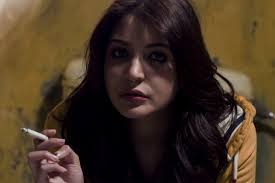 Some of the page 3 discussions early on in the movie seem forced. But they help establish the characters Meera and Arjun. And thankfully, not a lot of screen time is wasted on that. If I could, on hindsight, I would take out about 10 more minutes from the movie.
Overall, highly recommended movie for the week. Watch it to encourage more such movies. Watch it for Anushka.
(image courtesy – ibnlive and filmibeat)


 As I Was Saying